Eviction-Friendly Apartments in Fort Worth
A prior eviction does not have to block your housing search. See how Fort Worth properties treat filings vs judgments and how we pre-qualify you for approval.

Tarrant County has one of the highest eviction filing rates in Texas. Between 600 and 1,100 households face eviction filings every single week in this county alone. That volume means a massive pool of renters now carry a court record on their screening reports, often for situations that were dismissed or settled before a judge ever ruled.
Our team at Fort Worth Second Chance Apartments tracks exactly which local properties have shifted toward case-by-case reviews. You have real paths to approval, even if a recent denial has stalled your search.
This guide covers how Tarrant County courts create those records, what property managers actually see when they pull your file, and the specific steps required to get approved.
How Eviction Records Work in Tarrant County
Tarrant County uses 8 separate Justice of the Peace precincts to handle evictions. Your eviction record shows which precinct it was filed in, and that record appears on screening reports pulled by future landlords through the county’s public records system at dcsa.tarrantcounty.com.
| Record Type | Legal Meaning | Impact on Screening |
|---|---|---|
| Eviction Filing | Landlord submitted paperwork to a Tarrant County JP court. | Triggers many automated declines, even if dismissed. |
| Eviction Judgment | The JP judge ruled in favor of the property owner. | The most severe flag, usually accompanied by a money judgment. |
Many renters do not realize that a filing alone, not just a judgment, can trigger a denial. Screening companies like TransUnion SmartMove, RentGrow, and CoreLogic pull Tarrant County civil records and flag them regardless of outcome.
The terminology on your screening report varies:
- Filed: Paperwork submitted, no ruling yet.
- Dismissed: Case dropped or settled before a judge ruled.
- Judgment for plaintiff: Court ruled for the landlord, often creating a financial debt.
- Outstanding eviction filings: Multiple recent filings appear on your background check.
SB 14 Changed the Game in 2024
Senate Bill 14 took effect January 1, 2024 and overhauled Texas eviction procedure. The law makes the eviction process significantly faster. Judges can now issue summary disposition judgments in as few as 10 days for unauthorized occupants. Appeals require tenants to pay rent into the court registry within 5 days.
The practical impact is that more evictions are finalized faster, meaning more Tarrant County renters carry fresh judgments on their records. If you fell behind on rent in the last year, you likely have less time to recover before losing your unit than you would have under the old rules.
Recency: the Number One Approval Factor
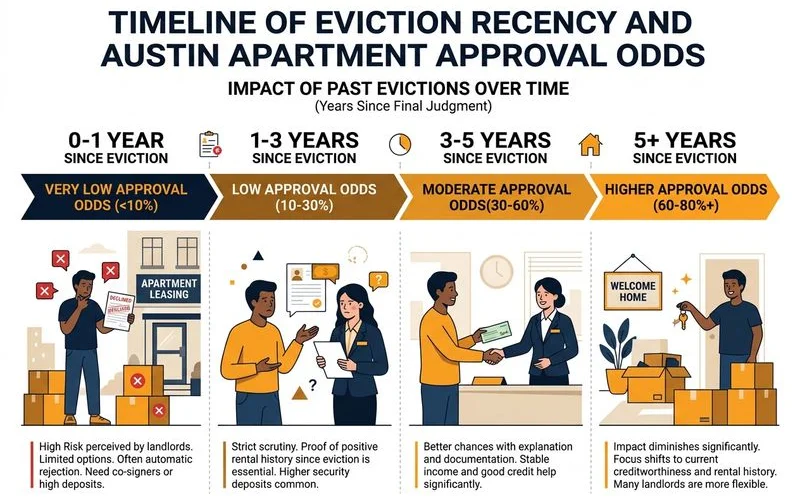
Time elapsed since the court date drives approval odds more than any other factor. Property managers view an older record as substantially lower risk than a recent judgment.
- Within 6 months: The hardest timeframe. Most properties decline immediately. Some second-chance specialists will review your file if you show strong income and a paid balance.
- 1 to 2 years: Moderate challenge. A meaningful share of case-by-case properties in Woodhaven, Polytechnic Heights, and the Las Vegas Trail corridor review applications with a paid ledger and a written explanation.
- 2 to 3 years: Considerably easier. Most second-chance properties will review your history, and many standard communities transition to case-by-case review.
- 5+ years: Many properties drop the heavy weighting entirely, especially if your rental history since the event is clean.
- 7+ years: Consumer protection laws dictate that tenant screening databases stop reporting the eviction after seven years.
What Case-by-Case Properties Want to See
Managers need documented proof that the previous issue is resolved. Prepare these materials before submitting any non-refundable application fees.
- Paid balance: A paid-in-full letter from the previous property is your highest-leverage document. If you owed money from the court judgment, settle it first.
- Landlord explanation letter: Write one page in your own voice. See our landlord explanation letter template for the correct structure.
- Strong income: Fort Worth properties typically demand 2.5x to 3x the monthly rent. With realistic second-chance rents running $800 to $1,200 for a 1-bedroom in the flexible corridors, you need to prove $2,000 to $3,600 in gross monthly income.
- Clean recent rental history: Managers look for 1 to 2 years of on-time payments since the filing.
- Larger deposit: Expect an increased security deposit or a non-refundable risk-mitigation fee.
The 12.4% Vacancy Rate Works in Your Favor
Fort Worth’s current market conditions are the best they have been for second-chance renters in years. The DFW metro vacancy rate hit 12.4% in early 2026, with downtown Fort Worth reaching 15%. Over 40% of listings now offer concessions.
When a property has 20 to 30 vacant units generating zero revenue, the math changes. A tenant with a 2-year-old eviction and paid balance who can prove income starts looking much more attractive than an empty unit producing nothing.
Properties that automatically decline an eviction flag will never change their mind, regardless of the compensating factors you offer. Applying to those buildings just wastes your $50 to $75 application fee. Our service exists to steer you toward the properties where your situation actually gets reviewed.
How We Match You to the Right Properties
We pre-screen your eviction record against the real criteria of properties across Tarrant County before you spend a dime on application fees. That means knowing which Woodhaven complexes review 2-year-old filings, which Ridgmar communities accept paid judgments, and which Las Vegas Trail properties approve renters with recent cases paired with strong income.
The process works because our team maintains direct relationships with property managers across the affordable corridors. We know their current screening policies, not the generic guidelines posted on their websites.
Tell us about your eviction, including the date, the outcome, and the balance status. Our team will match you to the properties in Fort Worth that actually approve situations like yours, through our second-chance apartment locating service.
Common Questions
Quick answers on eviction-friendly apartments in fort worth.
Can you rent after an eviction in Fort Worth?
+
Does a dismissed eviction still show up?
+
How soon after an eviction can I rent again?
+
Related Guides
Apartments That Accept Bad Credit in Fort Worth
Bad credit does not mean automatic denial. See how credit-flexible Fort Worth properties evaluate applicants and how our free locators find ones that approve.
Apartments That Accept Broken Leases in Fort Worth
A broken lease flag is not the end of your search. Learn how Fort Worth properties review broken leases case-by-case and how we match you to ones that approve.
Which Fort Worth Apartments Accept Third-Party Guarantors
Cannot qualify alone? Third-party guarantors like Liberty Rent and The Guarantors can get you approved. See which Fort Worth properties accept them.
Ready for Second Chance?
Tell us your situation. We'll match you only with properties that approve renters like you, free of charge.
Same-day tours • 7 days a week • 100% free for renters