Fort Worth Apartments That Accept Third-Party Guarantors
Cannot qualify alone? Third-party guarantors like Liberty Rent and The Guarantors can get you approved. See which Fort Worth properties accept them.

The barrier to qualifying for a Fort Worth apartment is often higher than renters expect. Most Tarrant County properties demand proof of gross monthly income equaling 2.5x to 3x the monthly rent. For a $1,100 per month unit in Woodhaven or Polytechnic Heights, that means proving at least $2,750 to $3,300 monthly income. A unit in the $1,400 range near the Alliance corridor requires $3,500 to $4,200.
If your income, credit, or rental history falls short, a third-party guarantor fills the gap without asking a family member for help.
Here is how each program works and which Fort Worth properties accept them.
How a Third-Party Guarantor Works
A third-party guarantor is an institutional co-signer you pay to guarantee your lease when you do not meet a property’s financial or credit requirements. They accept the financial risk on behalf of the landlord.
The process follows a specific order:
- You apply through the guarantor’s screening platform, which is generally faster than the property’s own screening.
- The guarantor approves or declines you and charges a fee.
- The apartment accepts the guarantor as the official lease co-signer.
- If you ever miss rent, the guarantor pays the landlord immediately and then collects the debt from you.
The primary advantage is independence. You do not have to ask family members for help. The major trade-off is cost: you pay a substantial one-time fee you never get back.
The Main Programs Available in Fort Worth
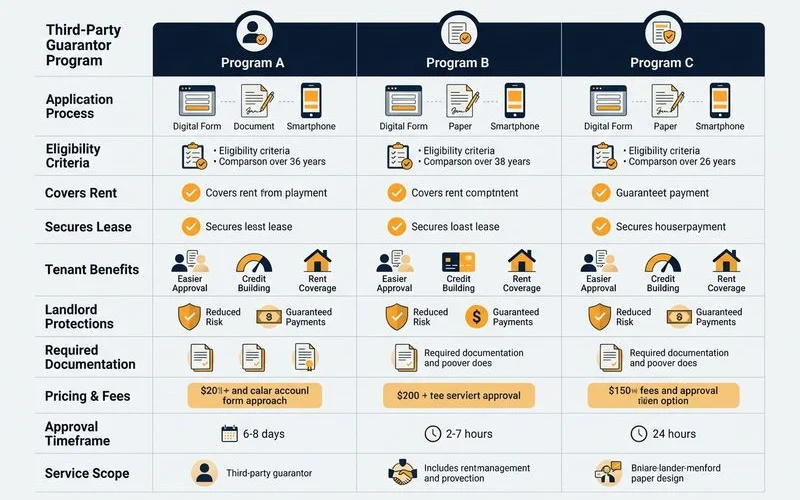
Four primary companies dominate the guarantor market. Their acceptance varies widely based on the specific property management group. The landlord dictates which vendor they allow, so you cannot use just any service.
Liberty Rent
Liberty Rent is the most common choice for second-chance leasing in the Fort Worth area. Many mid-tier and value properties accept this vendor.
- Criteria: They approve based on income, employment, and an internal screening process. They frequently accept renters with broken leases and prior evictions case-by-case.
- Income benefit: They often lower the required income ratio to 2x or 2.5x rent.
- Cost: A $75 application fee. If approved, the access fee is typically equal to one month of rent, paid upfront.
The Guarantors
The Guarantors operates nationally and partners with large corporate management groups like Greystar. Their underwriting is slightly stricter than Liberty Rent.
- Acceptance: Widely accepted at larger complexes and some newer builds.
- Cost: The fee ranges between 50% and 80% of one month’s rent for a one-year lease, depending on your credit profile.
- International renters: Those with zero US credit history might see quotes closer to 90% of one month’s rent.
OneApp Guarantee
OneApp Guarantee focuses specifically on bridging housing gaps for lower credit profiles.
- Cost: Typically one month of base rent.
- Payment plan: They offer 25% upfront with the rest in five equal monthly payments. Using the payment plan adds a 5% risk fee, making the pay-in-full option cheaper.
Insurent
Insurent appears mostly at higher-end properties. We typically use them for international relocations or students.
- Requirements: Annual income of 27.5x the monthly rent for US citizens.
- Cost: Fees run between 65% and 90% of one month’s rent.
When a Guarantor Makes Financial Sense
A guarantor is ideal when your financial gap is temporary or paperwork-related rather than an inability to pay monthly rent.
The math works in your favor when:
- Income is the only gap. You carry a 600 credit score and clean history, but your verifiable income sits at 2x rather than the 2.5x the property wants.
- You are relocating for work. Moving to Fort Worth for a position at Lockheed Martin, the Alliance corridor, or a hospital role means you may not have local paystubs yet. A guarantor substitutes for that missing history.
- You lack US credit. International workers and students bypass the standard credit check entirely.
- You prefer financial independence. Keeping financial matters separate from family is a valid and common choice.
The math works against you when:
- The fee exceeds what you would pay in a larger deposit.
- The property accepts a risk mitigation fee of $200 to $500 that is cheaper than a guarantor policy.
- You qualify at a different property without needing the guarantor at all.
Verify Before Paying
Always ask the leasing office for their exact third-party vendor list before submitting any application. Assuming a property accepts a specific company wastes money.
Confirm these details first:
- Vendor acceptance. Ask the leasing agent directly. Liberty Rent is widely accepted at mid-tier Fort Worth properties; The Guarantors is slightly less common outside corporate-managed buildings.
- Coverage limits. These policies protect the landlord, not you. Most cover unpaid rent but rarely cover early-termination fees.
- Base criteria. A guarantor solves income and credit issues. It does not automatically override felony convictions or property-specific background denials. If low credit is your main flag, our guide to apartments that accept bad credit covers properties that screen on income instead.
Cost-Benefit Comparison
A guarantor fee on a $1,100 per month Fort Worth apartment (roughly $13,200 annual rent) runs approximately $660 to $1,050 as a one-time charge. Compare that to the alternatives:
| The Guarantor Path | The Rejection Path |
|---|---|
| One-time policy fee ($660 to $1,050) | Multiple application fees ($50 to $150 per attempt) |
| Standard security deposit ($200 to $500) | Demands for two extra months of deposit ($2,200) |
| Move in immediately | Extended hotel stays ($1,500+ per month) |
| Clear predictable cost upfront | Months of wasted time and credit score damage |
How We Help
Our service matches you directly with Fort Worth properties that accept these specific programs. We confirm guarantor acceptance with the leasing staff before your application goes out, preventing the property from stalling and leasing your unit to someone else.
Stacking guarantor policies with other compensating factors is a core part of second-chance apartment locating. The service is completely free.
If you are tired of getting rejected, tell us your situation. We will match you with Fort Worth properties that accept Liberty Rent, The Guarantors, and other programs we have direct placement experience with.
Common Questions
Quick answers on which fort worth apartments accept third-party guarantors.
What is a third-party guarantor for an apartment?
+
How much does Liberty Rent cost?
+
Do all Fort Worth apartments accept guarantors?
+
Related Guides
Apartments That Accept Bad Credit in Fort Worth
Bad credit does not mean automatic denial. See how credit-flexible Fort Worth properties evaluate applicants and how our free locators find ones that approve.
Apartments That Accept Broken Leases in Fort Worth
A broken lease flag is not the end of your search. Learn how Fort Worth properties review broken leases case-by-case and how we match you to ones that approve.
Eviction-Friendly Apartments in Fort Worth
A prior eviction does not have to block your housing search. See how Fort Worth properties treat filings vs judgments and how we pre-qualify you for approval.
Ready for Second Chance?
Tell us your situation. We'll match you only with properties that approve renters like you, free of charge.
Same-day tours • 7 days a week • 100% free for renters